WHY DOES
OSTRIUM EXIST?
Capability boundaries move. Ostrium asks what determines how quickly—and which parts of that process can be deliberately improved.
THE QUESTION
How far can intelligence go? For Ostrium, intelligence matters insofar as it can help turn an unknown into a validated capability. A more powerful model is a possible tool in that attempt.
The ambition is to expand what humanity can observe, understand, manipulate, inhabit, and experience. Those are different forms of access, each with its own costs and physical limits.
THE THESIS
Progress has latency. Questions, hypotheses, reasoning, experiments, validation, and engineering all consume time. Accelerating one stage may simply move the bottleneck to another.
The narrower TC-H hypothesis asks whether systematic improvements to a research loop reduce total wall-clock time for a defined, reproducible capability class. Historical technological change motivates this inquiry; it does not establish the answer.
READ THE FOUNDING ESSAY →THE METHOD
Register a falsifiable question. Define a matched counterfactual, independent evaluation, and kill conditions. Measure the whole loop. Record failures and the limits of every result.
No replicated results are currently recorded for the time-compression programs. A working instrument, a compelling metaphor, and a faster reasoning phase cannot substitute for those results.
INSPECT TC-H →THE OPERATING SYSTEM
Capability. Correctability. Exit. The frozen constitution governs how Ostrium operates, including under competitive pressure and recursive improvement.
A research system that cannot detect errors, recover from them, or leave its dependencies may accumulate power while losing the ability to learn from evidence.
READ THE FROZEN OPERATING SYSTEM →THE FIRST INSTRUMENT
Loams is the durable information substrate underneath the attempt: state and retrieval beneath replaceable compute. Research systems need memory, reproducible artifacts, and portable history before increasingly autonomous workflows can be trusted.
Its maturity and limitations belong in the project record. Loams is an engineering instrument, not evidence that TC-H succeeds.
READ THE INSTRUMENT RECORD →THE APERTURE
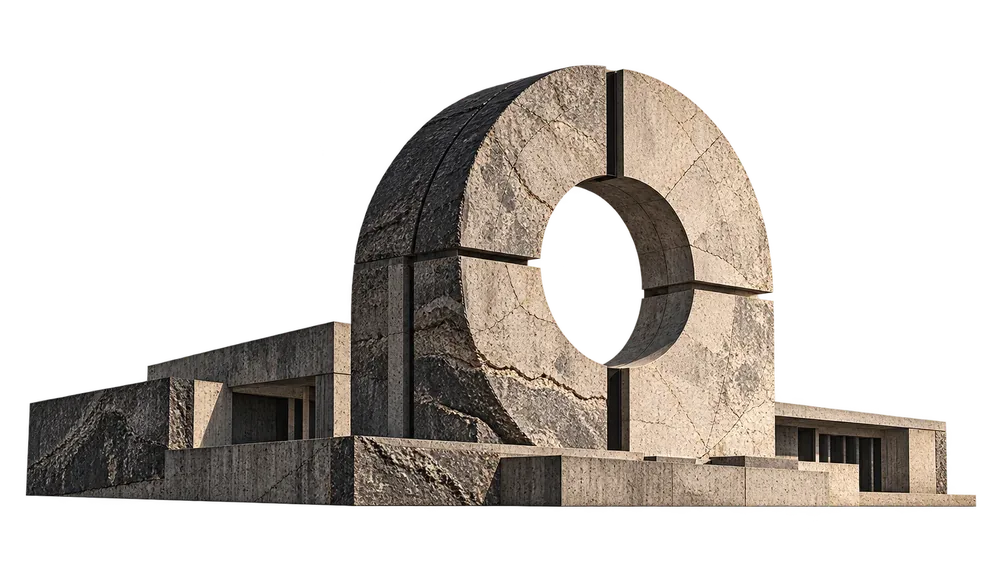
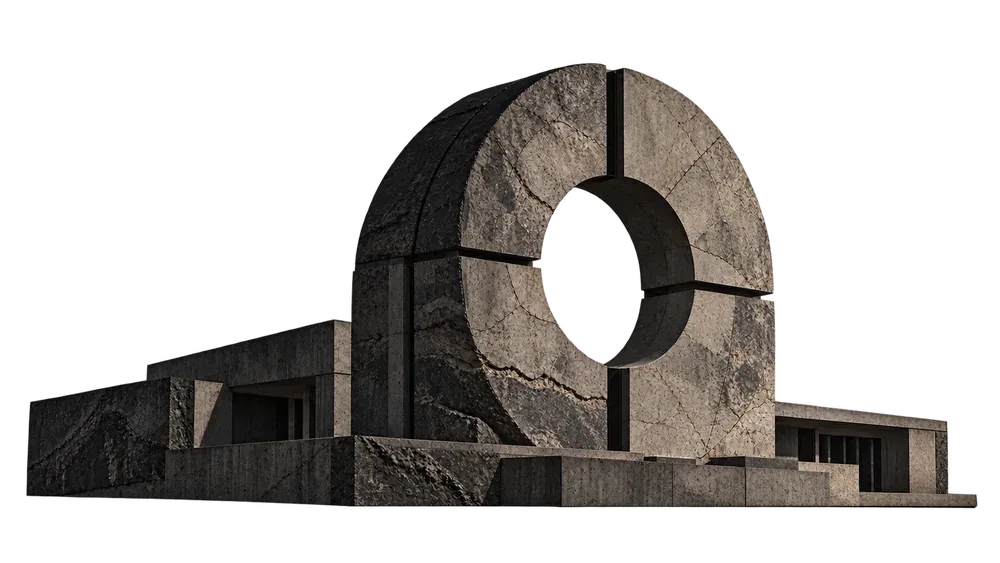
The circular stone observatory in Ostrium imagery is fictional: visual mythology for a question about time, scale, and observation. It is not a building, a facility, or a piece of Ostrium infrastructure.
Ostrium has no campus, laboratory building, or observatory. The landscapes and geological plates are generated illustration, documented with their prompts; none of them is evidence.
The institution's symbol comes from the same instrument: its configuration at midnight, drawn as a mark.
READ ABOUT THE MARK →THE HORIZON
“Make the impossible ordinary” and “a century into a second” are founding horizons. They keep the question uncomfortable without making a forecast or overriding physical law.
Recursive Compression explores whether the machinery producing progress can itself become improvable. It remains non-canonical, unregistered exploration. Later research scales do not follow inevitably from an earlier success.
The horizon does not need to be believed. It needs to be investigated.
WHAT HAS ACTUALLY BEEN DEMONSTRATED? →